Monroe County, Alabama
Burnt Corn Spring is one of the most significant locations along Alabama’s Old Federal Road. Although today it appears to be a quiet roadside spring, it played an important role in the events leading to the Creek War of 1813–1814. Travelers on the Federal Road stopped here for fresh water, and in the summer of 1813 both Creek warriors and American militia passed through this area. The spring also became the site of one of the earliest post offices established in this part of the Alabama Territory, making it important not only in wartime but also in the region’s early settlement.
Historical Marker
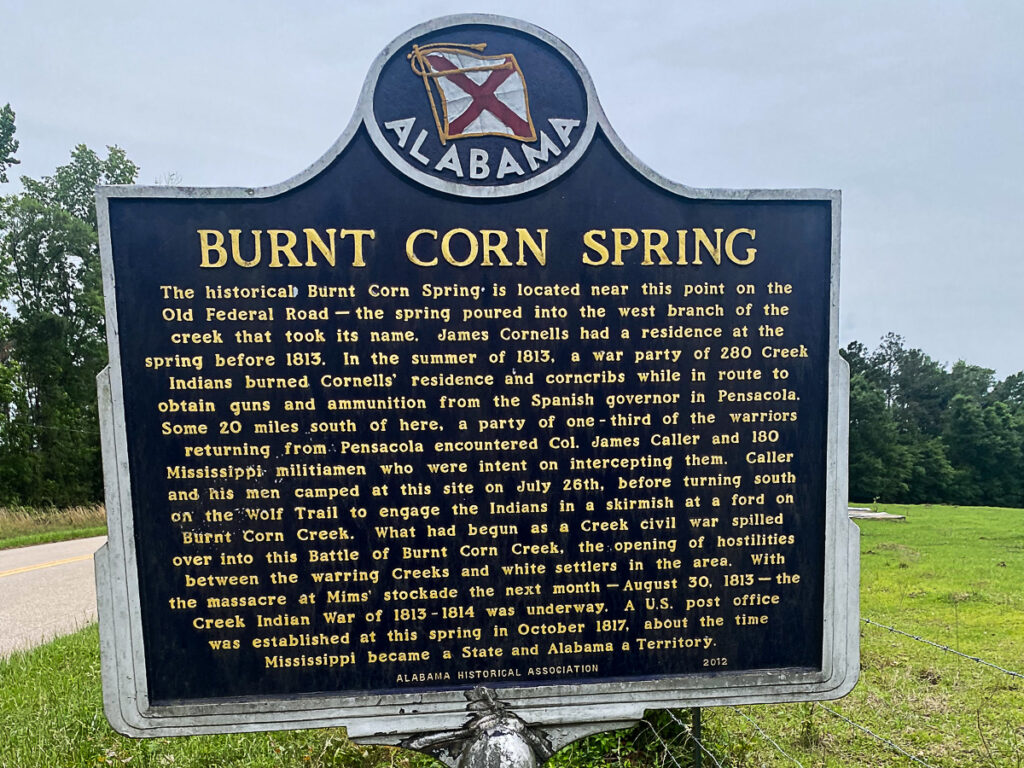
Marker Text
BURNT CORN SPRING
The historical Burnt Corn Spring is located near this point on the Old Federal Road—the spring poured into the west branch of the creek that took its name. James Cornells had a residence at the spring before 1813. In the summer of 1813, a war party of 280 Creek Indians burned Cornells’ residence and corncribs while en route to obtain guns and ammunition from the Spanish governor in Pensacola.
Some 20 miles south of here, a party of one-third of the warriors returning from Pensacola encountered Col. James Caller and 180 Mississippi militiamen who were intent on intercepting them. Caller and his men camped at this site on July 26th, before turning south on the Wolf Trail to engage the Indians in a skirmish at a ford on Burnt Corn Creek. What had begun as a Creek civil war spilled over into this Battle of Burnt Corn Creek, the opening of hostilities between the warring Creeks and white settlers in the area. With the massacre at Mims’ stockade the next month—August 30, 1813—the Creek Indian War of 1813–1814 was underway.
A U.S. post office was established at this spring in October 1817, about the time Mississippi became a State and Alabama a Territory.
Old Federal Road Project
Burnt Corn Spring reminds us that the Old Federal Road was far more than a route connecting settlements. It served as a military road, a trade route, a mail route, and the stage upon which some of Alabama’s most important early history unfolded.
In the summer of 1813, Creek warriors traveling to Pensacola for arms passed this very spring. Colonel James Caller and his Mississippi militia camped here before marching south to intercept them, leading to the Battle of Burnt Corn Creek. Although the battle itself occurred several miles away, many historians recognize it as one of the opening engagements of the Creek War.
The conflict quickly escalated. Just over a month later came the attack on Fort Mims, drawing the United States into a broader campaign that ultimately ended Creek resistance and opened millions of acres of land for settlement across what would become Alabama.
By 1817, the violence had given way to settlement. The establishment of a U.S. Post Office at Burnt Corn Spring illustrates how rapidly this frontier changed from a contested wilderness into an organized community connected by the Old Federal Road.
Today, little remains beyond the historical marker and the quiet countryside, but this location stands as one of the key landmarks in understanding both the Creek War and the development of Alabama’s earliest transportation corridor.
YouTube Video
Location
Burnt Corn Spring Historical Marker
Monroe County, Alabama
31.51645, -87.16888