Monroe County, Alabama
Puryearville was once an important community along Alabama’s historic Old Federal Road. This marker tells the story of a Methodist congregation established during Alabama’s frontier days, a community that also served as a center for education, fraternal organizations, and early settlement in Monroe and Conecuh counties.
Historical Marker
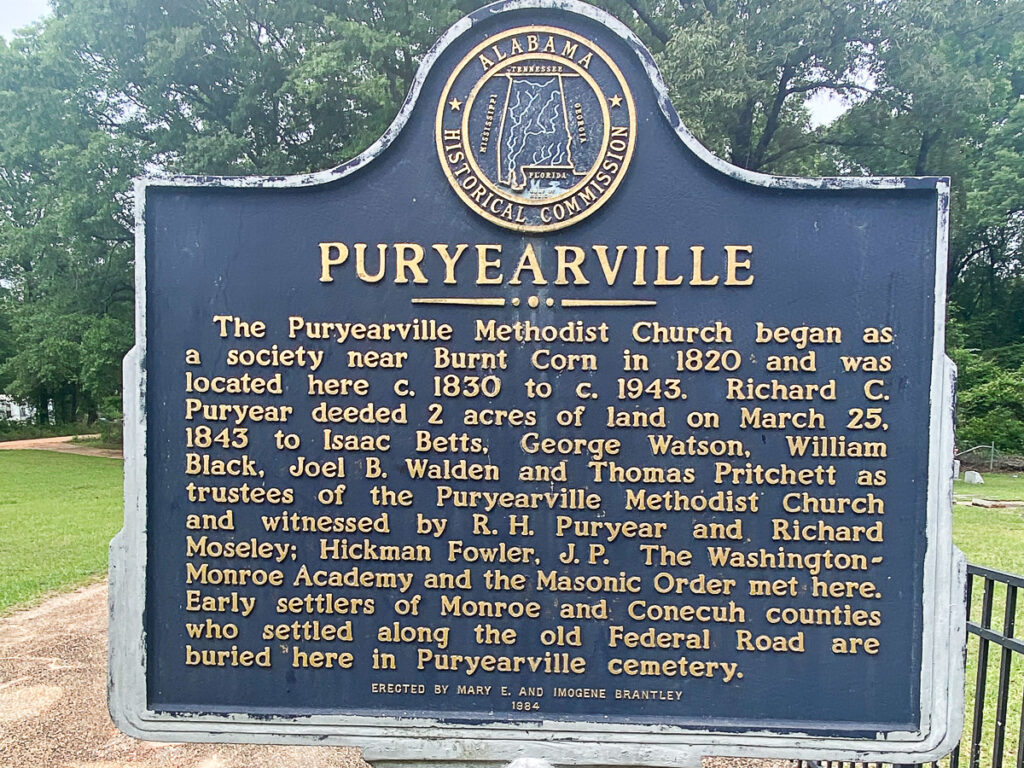
Marker Text
PURYEARVILLE
The Puryearville Methodist Church began as a society near Burnt Corn in 1820 and was located here c. 1830 to c. 1943. Richard C. Puryear deeded 2 acres of land on March 25, 1843 to Isaac Betts, George Watson, William Black, Joel B. Walden and Thomas Pritchett as trustees of the Puryearville Methodist Church and witnessed by R. H. Puryear and Richard Moseley; Hickman Fowler, J.P. The Washington-Monroe Academy and the Masonic Order met here. Early settlers of Monroe and Conecuh counties who settled along the Old Federal Road are buried here in Puryearville Cemetery.
Erected by Mary E. and Imogene Brantley, 1984.
This historical marker is part of my ongoing Old Federal Road Project, documenting every historical marker associated with one of Alabama’s earliest and most important transportation routes. The Old Federal Road connected the Mississippi Territory with the new settlements of the eastern frontier and played a vital role in the migration of thousands of settlers into Alabama during the early 1800s.
Each stop along the route tells another piece of the story of Alabama’s early communities, churches, schools, businesses, and the people who helped shape the state.
YouTube Video
Location
Puryearville Historical Marker
Monroe County, Alabama
31.54522, -87.19278